
Three Reeds in a Crosswind
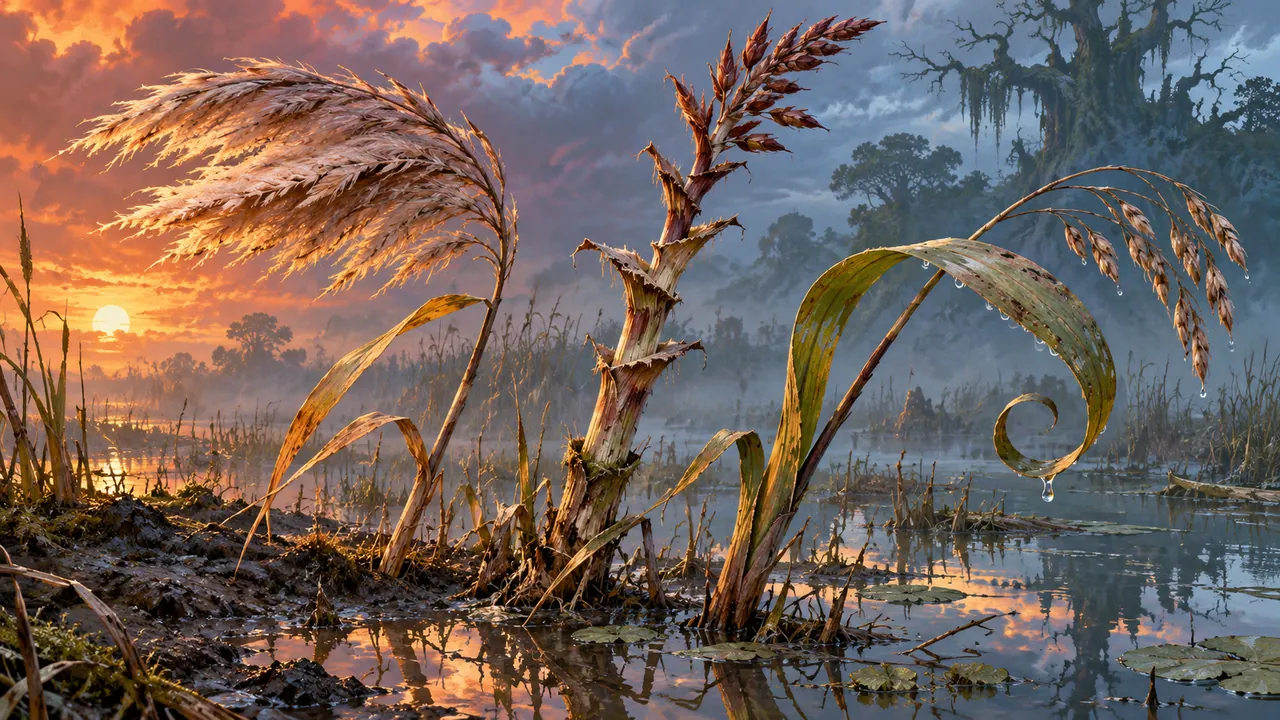
The edge of the marsh used to contain three kinds of reed with a different silhouette in a still frame. A player approaching in wind saw the heads turn in one direction. The most noticeable differences became hard to see as the stems folded over. In the fictional wetland of the prototype, identification is a choice about where the witch stands and whether she can wait for a second reading. We use three wholly invented plants so their game effects and appearances can be taught together. They have no uses outside the game. The illustration beside the note shows the seed head, stem, and leaf attachment at one readable moment.
Anchor a first look at the bank
At the bank, a kick in the creek runs between a low shelf and a bend in a plank laid on the mud. Put the first observation point at the edge of that shelf. From there the head of the reed we call dockshade divides as the upper leaves move away from one another. The split looks deeper when wind comes from the house. The other two plants roll their tips over into a tighter shape. If the player leaves that position too quickly, the fold can point away from the viewer and seem like a branch rather than a strand. The main reference is the position at which the leaves start to separate from the stem. It is lower in the image than anyone expects when looking only at the heads.
Change the angle before collecting
The other view sits beside a lower board just off the bank. Use it to check if the narrow blade is attached at the place you marked. The two neighboring stems overlap at a high point, while the dockshade attaches closer to the light-colored part of the bank. That gives another shape to compare without using the color of the blades. Inspect each reed from near enough to see the stem. It may be inconvenient to move back toward the house as the witch waits for the wind to settle. The pause is still a small enough cost to let the player choose a precise reading instead of settling for the nearest part of the stand.
Preserve the clue around later changes
The first view can become crowded if a float is moved into the corner of the bank. This was a useful condition to simulate. We removed the expected position of the entire seed head from one illustration and found that the leaf joint could still be indicated by light. The recessed spot behind the first correct stem stays dark, so we gave the shoulder a thin crescent of light that appears as the plant flexes. A band at the other edge stays steady long enough to show which motion belongs to the wind. We also keep a dry shoeprint on the shelf. It points back toward the angle from which both features can be seen.
Follow the decision home
Silt Cup Cure begins around these three invented plants and moves to a vessel whose contents respond to motion. A Stair Below the Waterline asks a similar question about recognizing one physical feature as it leaves your view. For the reed study, we want the player to distinguish the movement of a plant from the location of the feature they have observed. Someone who can turn back, find the same leaf joint, and name what remained in place has learned a small part of the marsh. The next draft will ask whether the shoulder stays readable when mist gives the water a brighter sheen near the lower board.
We can account for both views by keeping the bank’s shallow notch in the illustration. It offers a point of comparison even after the person examining the plant has stepped out onto the damp board.