
Humidity at the Cabinet
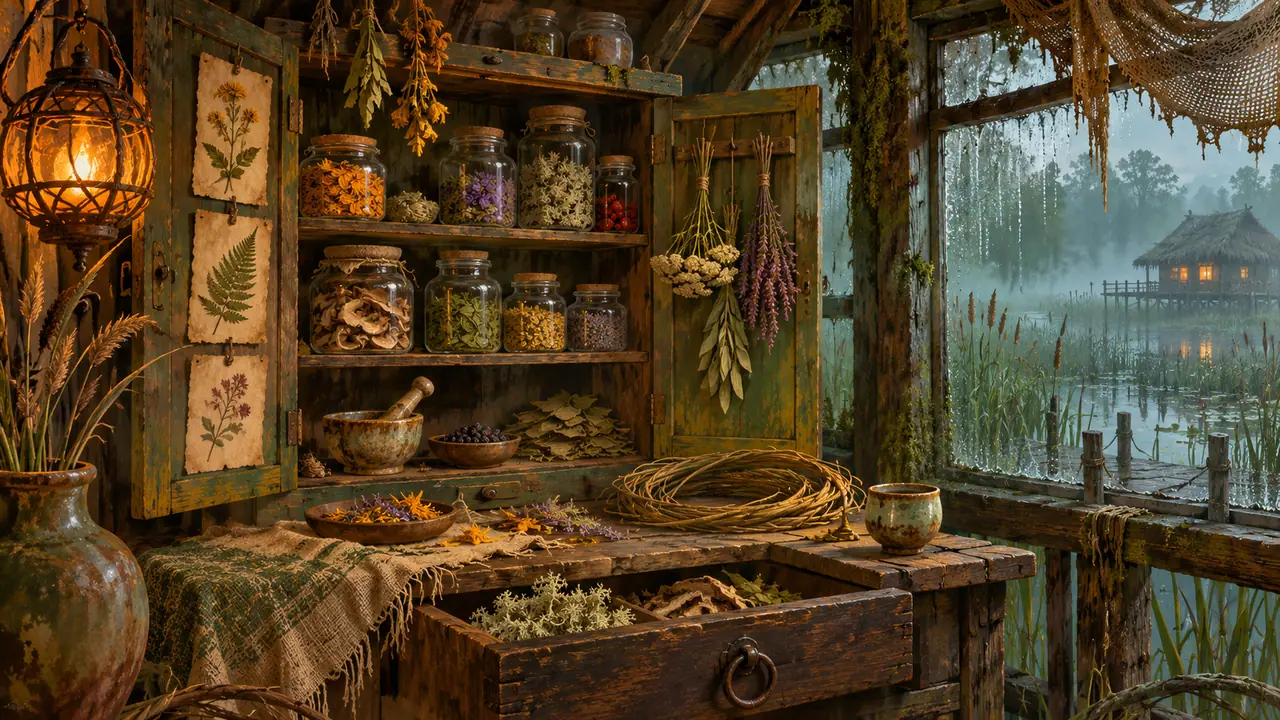
The cabinet in the marsh hut is above the usual flood line. That alone does not keep its contents dry. A partially open door rests where the incoming air rises past the stove. In the next scenario the witch may choose to leave the door wide enough to see which jars are inside, or close it until the water under the floor changes again. We wanted this corner of an invented room to affect what the player can observe. The cabinet condition has a purpose because several routes bring a vessel to it at different angles and different moments.
A first reference on the outer sill
Before the first cup is brought indoors, check a pale patch of wood beside the cabinet. The patch occupies the part kept under the edge of the door. Darker wood reaches the lower tip of one hinge. When the door opens farther, the new boundary between dark and pale shifts. We use that change as part of a small visibility test. A witch can learn how far the door was open the last time she passed it. She can use the information to decide where to set a fragile object without unloading all the other tools. The same observation also tells her which wall she can use to check that the platform was at a different angle before the water changed.
Look for a reliable container edge
One jar has a lighter shoulder. Another is sealed with a cloth top that fits wider than the rim. Both are invented pieces of equipment for the fictional game. A damp band can make the lighter shoulder disappear against the reflection from the door. We tested a broad opening in the design and moved the jar back a short length to make room for a shadow. The narrow dark line behind it lets you judge the jar’s position when the light shifts. A second, shorter view works from the end of the shelf. This makes an identification possible for someone carrying a load that prevents them from moving into the corner next to the stove.
Use the door as a reversible choice
With the door partway open, the gap between its edge and the wood shows how far you can reach. The player can move a load from one shelf to a second one and close the door. The next view retains the position of that load while the outline of the wet patch changes. We keep the state simple because the problem is the readability of the place, rather than an elaborate real-world model of humidity. A sound near the top hinge tells the player that the door has caught in its intended resting position. When the sound is missing the load can be moved closer to the other side of the rack. We make the unclasped state visible without requiring someone to turn the brightness up.
Let a constraint survive its first use
Silt Cup Cure approaches the cabinet after a narrow crossing. The position of its door can reserve a useful rest for the cup. Returning by the Leeward Wall follows the same area from an angle that makes the open part of the cabinet harder to see. It describes a place across the water from which the witch can observe the hinge, then choose which part of the room she wants to enter. Future tests could compare two cabinet heights while the water under the hut is at the same depth. We will watch whether the player can still identify the open space beside the stove before deciding where to set her cup.
The fixed comparison will be a plain strip on the floor by the rest. Keep that strip in both views so the hinge’s distance from the rest can be judged after the camera moves.